
A dog backpack. Many dog owners smile when they see one and think: that's completely unnecessary. Then comes the moment when their dog refuses to walk any further, stairs become a problem, or the terrain simply doesn't allow their four-legged companion to go on foot. And suddenly, the dog carrier backpack is the most practical thing they could have brought.
This article is based on real experiences shared by our customers – people who told us how they actually use their dog backpacks. These are real situations, not marketing.
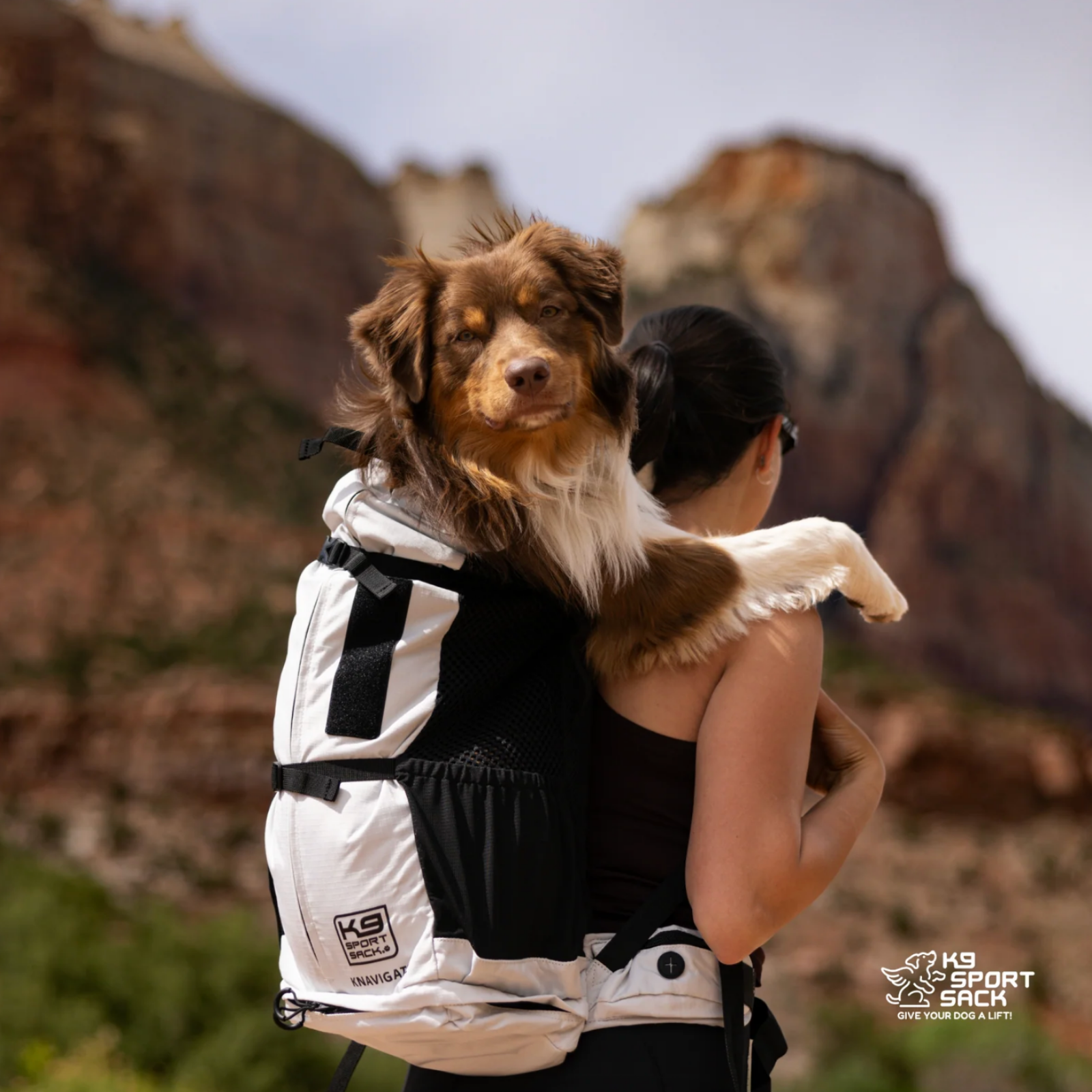
Before You Start: A Dog Backpack Is a Tool, Not a Transport Vehicle
This needs to be said right at the beginning, because your dog's health depends on it.
A dog backpack is a great tool – but only when used responsibly. Your dog should ideally spend 20 to 30 minutes in the backpack, a maximum of 40 minutes at a stretch. If the backpack is tilted – for example during cycling – this limit is even stricter, because the position of the dog's body is less natural and puts more strain on breathing and the spine.
After each stretch in the backpack, your dog needs to:
- get out and stretch
- explore the surroundings
- have a drink of water
- walk on their own for a bit, if the situation allows
A dog backpack is not a crate or a carrier for the whole day. It is a tool for specific situations and specific sections of a journey. An owner who respects this has a happy and healthy dog. An owner who ignores it risks stress, overheating and physical problems.
Keep this in mind as you read through each of the situations described below.
K9 sport sack and Little Chonk backpack for dogs available here!
1. Cycling – A Dog Backpack as a Safe Solution for Busy Cities and Forest Trails
Cycling and dogs are a great combination. But not always.
Customers most often write to us about two scenarios. The first is cycling through a busy city – for example using Rekola bikes around Prague or cycling in Amsterdam. Crossing an intersection, tram tracks, crowds of people – these are situations where having your dog on a leash next to your bike is an unnecessary risk for both of you. A dog in a backpack sits safely, has a view, and you have both hands free and a clear head.
The second scenario is crossing a busy road to reach a forest or nature trail. A relaxing trip starts with a stressful crossing where you can't safely control your dog and ride your bike at the same time. A dog backpack simply eliminates this problem.
Tip: If you're looking for a dog backpack for cycling, look for models with a waist strap for better weight distribution and stability on the move.
K9 sport sack and Little Chonk backpack for dogs available here!
2. Motorcycle – Only Transport You Have, and the Dog Is Coming With You
Not everyone has a car. And not everyone wants to leave their dog at home just because they're riding a motorcycle.
Customers who use a motorcycle as their main mode of transport describe situations where a dog backpack worn on the back is the only sensible solution. The dog sits securely, their head pokes out, the owner has both hands free and can ride safely.
It's important to choose a backpack with a solid structure and a safety clip that keeps the dog secured inside. On a motorcycle, the short-stretch rule applies even more strictly than elsewhere – vibration and airflow are physically more demanding for a dog than walking. Plan regular stops where your dog can get out and rest.
3. Roller Skates and Skateboard – Cycle Path, Beer with Friends, No Compromises
This is a situation that may have crossed your mind, but not many people talk about it.
You're skating or skateboarding along a busy cycle path. A dog on a leash in this situation is not just inconvenient, but potentially dangerous – for the dog, for you, and for others around you. One unexpected move, one moment of hesitation, and the situation can quickly spiral out of control.
A dog in a backpack simply comes with you. Cycle path, park, busy street – no stress, no pulling on the leash, no deliberating whether to bring the dog or leave them home. You skate over to a friend's for a beer, your dog comes along, and you don't have to compromise on your hobby at all.
This is exactly what customers describe as one of the most practical reasons they bought a dog backpack. Not a mountain hike. Just a normal active day with their dog by their side.
4. Puppies – Tired Little Legs and Healthy Musculoskeletal Development
This is about more than comfort. It's about health.
All puppies, and especially those of larger breeds – Labradors, German Shepherds, Flat-Coated Retrievers and others – should not be physically overloaded until roughly 12 to 18 months of age. Their musculoskeletal system, especially joints and bones, is still developing. Excessive strain during this period can lead to hip dysplasia or other orthopaedic problems that will affect the dog for the rest of its life.
And yet every puppy owner knows how it goes: the puppy wants to walk, then stops, then refuses to go any further, and you're standing in the middle of a forest wondering what to do next.
A dog backpack used as a dog carrier is a natural solution for puppies. A short trip that you'd otherwise have to cut short becomes perfectly manageable. The puppy rests, watches the world from above, and the musculoskeletal system isn't put under more strain than is healthy.
5. Health Problems – When a Dog Backpack Is Not a Luxury, but a Necessity
This is an area that doesn't get talked about much, but dog owners write to us about it a lot.
Arthritis and back problems – especially in Dachshunds, Basset Hounds and other long-spined breeds, stairs are a real problem. A dog carrier backpack makes it possible to carry them past the difficult spots without any strain on the affected area.
Reflux and oesophagitis are another example. When a dog has inflammation of the oesophagus, they must not walk down stairs or adopt a position where stomach contents travel back up. Rest and a horizontal body position are essential. A dog backpack allows you to control the dog's posture even when moving.
After surgery and during rest periods – your dog needs to rest, but you don't want to keep them unnecessarily cooped up indoors. A backpack allows a short trip to get some fresh air – perhaps just to the park around the corner – without putting any strain on the affected area.
All K9 sport sack dog carriers and Little Chonk Maxine one available here!
6. Hiking and Difficult Terrain – When Your Dog Simply Cannot Go Any Further on Their Own
Via ferratas, ladders, rocky passages, fast-flowing streams or steep drops. There are places a dog simply cannot get through on their own – not because they're lazy, but because it's physically impossible or unsafe.
A dog backpack designed for hiking is made exactly for these situations. The dog sits securely, the weight is distributed across the carrier's back, and both hands are free to grip rocks or a ladder.
Customers describe situations from the Adršpach Rocks, trips in the Tatras, or trails that passed through places only accessible to humans on two legs. In these moments, a backpack is not an optional accessory. It's the only way to bring your dog along.
Practical tip: Before heading out onto difficult terrain, let your dog get used to the backpack at home. Start with short stretches and reward generously.
7. Fishing – When You Want Your Companion Right There in the Water
Anglers who wade through rivers or fish directly in the water want their dog with them. But a dog in the water is both a risk and an obstacle when fishing. A dog backpack allows a fisherman to bring their dog along, carry them past dangerous sections, and keep them safe while getting on with the fishing.
It's a niche use case, but if you're an angler with a dog – you know exactly what we mean.
8. Senior Dogs and Dogs with Limited Mobility – Everyday Use
An older dog with arthritis, a dog recovering from sterilisation, a dog with an injured paw – all of these cases require temporary or long-term restricted movement. A dog backpack makes a daily outing possible, which matters hugely for the dog's mental wellbeing, without putting any strain on the affected area.
Customers described situations where their dog couldn't walk on outdoor terrain for 6 weeks after a paw operation, but thanks to the backpack could get outside every day and didn't grow frustrated from being stuck indoors.
9. Travel – Metro, Shopping Centres, Busy Cities
The metro, a busy train station, a shopping centre or a crowded tourist street – in these situations a dog on the ground in a crowd is either stressed or at risk of being stepped on. A dog backpack is more practical than a carrier crate and more comfortable than holding your dog in your arms.
How to Choose the Right Dog Backpack?
Before you reach for the first one that looks good in photos, check:
- Weight capacity – a dog backpack for 10 kg and one for 15 kg or up to 45 kg are different products with different framing and weight distribution
- Ventilation – airflow is especially important in summer
- Back panel and strap quality – cheap versions will start cutting into your shoulders on longer walks
- Safety clip – your dog should be secured inside the backpack, not just sitting loosely
- Acclimatisation – every dog needs time to accept the backpack as a safe place; never put them in it for the first time on a demanding trip
A Dog Backpack Is Not for Every Dog or Every Situation
Let's be honest: not every dog will accept a backpack. Some dogs have difficulty with restricted movement, are claustrophobic, or simply don't feel comfortable inside. In that case, it's better to look for alternatives or introduce the backpack gradually using positive reinforcement.
A dog backpack is a tool, not a solution for everything. But in the situations described above – confirmed by dog owners themselves – it can significantly expand what you and your dog are able to do together.